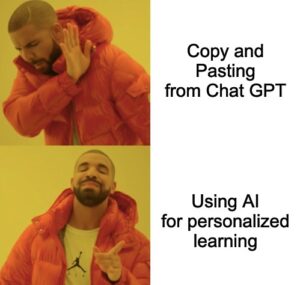
After meeting 1on1 to review my Synthesis Essay, I realized that my essay was not complete. It was very unorganized and lacked connection and flow throughout the essay making it seem as if it was just information without a purpose. So I focused on creating an introduction that got straight to the point and introduced my thesis and then moved on introducing my information and instead of giving background information I felt as though creating a clear and positive connection that aligned with my thesis was important. I decided to keep my quotes concise but powerful to move away from just spitting information and finished with a reflection type conclusion that could be seen in an argumentative style essay I’ve done in the past.
First Draft
The first time I found ChatGPT, it felt like I found a cheat code. It generated chemistry questions for me to study and practice on before my tests, it gave me step by step solutions for my geometry homework when I was stuck, and overall made my assignments so much easier for me to handle. But after a while I wasn’t sure, was I actually learning or just depending on AI to think for me?
When ChatGPT became public in 2022, it was an overnight sensation. Students could write essays, solve questions, and complete homework assignments with a simple prompt. Homework was an issue for students no more and this sparked a controversy around this change in education. Was AI truly gonna revolutionize education for every student or was it a shortcut that threatened the core principles students needed to be taught? Like every new technological advancement, like the internet and technology itself, it strikes fear and doubt into believers of what’s traditional. But as we begin to develop and grow around AI, it begins to open a whole new world not yet seen. AI isn’t replacing what we already know, it is reshaping our understanding of it. While AI has caused fear and controversy in education, in the end it benefits students and teachers when used as tool
In my ways we can already see how AI has already started reshaping the way students learn and teachers teach. Hannele Niemi, a Research Director in the Faculty of Educational Sciences at the University of Helsinki, in her book, “AI in Learning: Designing the Future”, emphasizes that AI is extremely powerful and has incredible potential in education. Niemi supports this idea by relating facts used in her own studies, illustrating how AI has many different applications within education. She writes that AI is already incorporated in students, teachers and administrative positions, stating that AI has been useful in reviewing and grading students assignments and has been shown to be more helpful than the purely human feedback. With all the potential of AI in education, we need to understand how students are actually affected by AI. Microsoft, a major global tech company, in their special report, “2025 AI in Education”, illustrates that AI in classrooms has both comforted and raised concerns for students and teachers. Microsoft, reinforces this claim by relating real world surveys of students and teachers, illustrating key benefits and problems faced by the use of AI. However, Microsoft goes on to imply that we need to Reimagine the Future of Education through AI, using studies that say that AI has helped students overcome creativity problems, motivating students to interact outside of the classroom. So we can see that AI has already seen major impacts and improvements in schools. In the future there is no telling what AI can do when fully optimized. It has the power to refine education for all rather than cause complications.
The main problem with schools today is that not one person is the same. In today’s schools, we have many different learners, auditory, visual, or even hands on. But there is only so much that a single teacher can do with so many students and not enough time. AI can provide a solution to this problem by being individualized to a single student’s problem and learning style. Dr. M. Anto Juliet Mary, and Ms. Maria Joyce, Professors from Mount Carmel College for Women (Autonomous) Bengaluru, in their report, “AI and Education: Impact of AI on Learning Outcomes in Higher Education” declares that a personalized education is beneficial for students. Mary and Joyce support this statement by illustrating the advantages AI delivers through a personalized learning experience for students. They write, “Integration of modern technology in higher education using personalized learning platforms has improvised and optimised the teaching methods. The intervention of AI has demonstrated change in effectiveness in the context of improving student performance and learning curve. Indeed, many interactive learning environment papers show considerable improvements in efficiency by demonstrating similar learning gains in reduced duration of time” (2). They later go on to imply that in order for a sustainable and effective approach to education, universities are considering adopting AI literacy courses as requirements in their programs. This paper crucially demonstrates how AI is becoming a tool that is vital for a deeper understanding in education for all, whatever anyone’s situation might be. In the article “After a Stroke, AI Helped Me Learn to Write Again” published in the journal Knowledge@Wharton in 2023, by founding editor in chief and executive director, Mukul Pandya, who suggests that AI has the ability to streamline the learning process by allowing one to focus on fewer things. Pandaya justifies this idea by relating his own personal experience when he lost the ability to write and edit pieces, and by illustrating scenarios where AI helped him on his journey back to being a writer and editor. He truly signifies the importance of AI when he states, “I focus on doing what I can do better than the AI and leave it to the AI to do what it does best.” (46). This piece is crucial in the fact that it gives a real world situation where traditional ways of learning or in this case re-learning aren’t viable and the use of AI is life changing and optimal. From this we can truly understand, AI isn’t a single use case, it is adaptable. Every single person can benefit from AI in their own way, every situation is different, every problem can lead to a new outcome. AI’s ability to become personalized to any individual is revolutionary in terms of learning to ones needs and is a step in a new and promising direction for education in any situation.
Many fear that AI will take over and replace teachers. But what those people do not realize is that, AI only knows things because of us. It knows and improves through the information we give it. “The future is already here: AI and education in 2025” a story published by Stanford University’s website, Stanford Accelerator for Learning, written by Isabel Sacks, who writes, “Researchers and technologists presented emerging areas of exploration … including collaborative classroom tools … speakers emphasized that AI should support, but not replace, human relationships.” (5). This scholarly article presents valid arguments and proof from a credible institution such as Stanford University that AI is steering education in a new direction. Along with this we see how valuable AI can be but only when it is used in conjunction with human intelligence. We see this clearly when we see, Salman Khan, CEO of Khan Academy, presents a TED Talk titled, “How AI could save (not destroy) education. Khan provides real world experiences used with his Khan Academy website, a tutoring website for students, to illustrate how important AI can truly be by allowing students to explore new opportunities one on one with a tutor while still receiving the necessary guidance and motivation from real teachers. He believes that AI should act as the coach, efficiently teaching students in a way that fits them the best, while still relying on the human teacher aspect for a more in touch and emotional connection. This perfectly shows how AI doesn’t need to replace teachers, it just takes the repetitive burden off the teachers shoulders and allows for a more focused approach on what the students really need in both capacities.
AI is misunderstood, many fear the possibilities of it instead of embracing the new capabilities found from the use of AI, especially in education. AI is transforming learning and making it more accessible and personalized for all. The growth of AI stems directly from the way that it is used by people, if people use it to cheat it will become no more than a shortcut that will stunt learning. However if used collaboratively and as a tool for efficiency it leads to limitless possibilities for growth. Consequently, AI can only do as much as you tell it to. That is why all educators and administrators should embrace AI, and become literate in the use of AI as it is the way of the future.
Final Draft
AI in the Classroom: Learning Tool or Shortcut
The first time I used ChatGPT, it felt like the craziest cheat code for school. It helped me create practice questions and flashcards to get ready for my chemistry tests, it gave me step by step solutions to teach me when I was stuck doing my geometry homework, and even made my English essay easier to handle. After a while though I started to wonder if I was actually learning anything or just letting AI take over as my brain. It feels like a lot of students and teachers don’t know how to feel, even more so with AI becoming more and more prevalent in school work. Some people think that it makes students lazy and helps them cheat, while others see it as a tool that can help students learn in their own way and schools are forced to decide how they are going to handle it. While AI may bring some challenges, it should be used in classrooms as it helps students learn better, supports teachers with their workload, and creates opportunities old-school teaching can not offer students.
In my ways we can already see how AI has already started reshaping the way students learn and teachers teach. In her book, AI in Learning: Designing the Future, Hannele Niemi, a Research Director at the University of Helsinki, emphasizes how AI has rapidly grown and has incredible potential in classrooms. She argues that AI is already being used in different areas of education, which includes the students, teachers, and administrators. Niemi illustrates the idea that even teachers were able to use AI to review and grade students’ assignments assisting them in providing better feedback for students and streamline their work. Similarly, in the report 2025 AI in Education, published by Microsoft, a major global technology company invested in AI, shows us how AI impacts are real and are being experienced in schools around the country. Microsoft’s report presents surveys taken where students and teachers illustrate the benefits and concerns of AI tools. Although there are concerns about cheating, the report highlights that AI has helped students overcome creativity problems and interact outside of the classroom. Microsoft continues to conclude that schools must “Reimagine the Future of Education” by using AI to support learning both in school and at home. Together, both Niemi and Microsoft were able to show that AI has already seen major impacts and improvements in schools. Niemi provides evidence in the different roles in education and Microsoft supports this claim by showing its effectiveness and its impact already in its report. Truly supporting the idea that AI should not replace education but transform it into something new.
One of AI’s biggest strengths is how it is able to personalize learning for every student, something schools today struggle with. This is a problem because not every student learns the same way, but there is only so much one teacher can do in the classroom. In the scholarly report, AI and Education: Impact of AI on Learning Outcomes in Higher Education, professors M. Anto Juliet Mary, and Ms. Maria Joyce, inform educators about AI’s ability to personalize learning for specific students. They support this claim by illustrating how AI is able to adapt to each student’s specific pace and style of learning. Mary and Joyce go on to explain that, “The intervention of AI has demonstrated a change in effectiveness in the context of improving student performance and learning curve.” This idea of personalized learning is crucial for being able to adapt and still grow regardless of the situation. This idea is supported further by Mukul Pandya’s personal experience with AI. In his article, After a Stroke, AI Helped Me Learn to Write Again, published by Knowledge @ Wharton, Pandya suggests that AI has the ability to streamline the learning process. He justifies this idea by writing about how AI helped him relearn writing after a stroke left him unable to communicate the way he used to. He signifies the importance of AI when he writes, “I focus on doing what I can do better than the AI and leave it to the AI to do what it does best.” (46) This piece is crucial in the fact that it gives a real world situation where traditional ways of learning or in this case re-learning are not viable and the use of AI is life changing. This provides the example to the data provided by Mary and Joyce showing how AI can personalize learning for specific needs. Together they prove that AI is not a one size fits all tool, it adapts allowing for the user to adapt as well.
Many fear that AI will take over and replace teachers. However, what those people do not realize is that AI learns from us. AI only knows and improves based on the information we give it. Therefore, it supports teachers instead of replacing them, making learning stronger overall. On Stanford University’s Stanford Accelerator for Learning website, Isabel Sacks’s report, The future is already here: AI and education in 2025, explains that researchers agree heavily that AI should “support, but not replace, human relationships” in the classroom. Sack goes on to argue that AI is valuable, but that AI experts believe that teaching requires a human connection that cannot be replaced by AI. This argument is strengthened by Salman Khan, CEO of Khan Academy, in his TED Talk, How AI could save (not destroy) education. Khan explains that AI can be a personal tutor for students while teachers focus on emotional support and motivation. Khan provides a real world experience from his tutoring platform to illustrate that AI can handle the repetition of the lesson, and let the teachers spend time connecting with the students. Sacks presents the idea arguing that AI should remain second to human teachers, while Khan provides examples of teachers and AI working efficiently. They piggyback off each other refuting the claim that one day AI will take over teachers in education, assuring the fact that AI is just the helper for teachers to focus on students’ education.
AI has and will continue to become a major part of how students learn, and no matter how misunderstood, it will continue to develop in classrooms. The way schools choose to use AI now, will determine the future of education. The doubt that comes from cheating or lack of learning, stems from how we apply it now and how we choose to embrace it. When used in the right way, AI helps students understand the material better, it gives them a personalized experience, and allows for the teacher to focus on the education that needs a real human connection. Cheating can happen with anything, but avoiding AI leaves the students at risk of falling behind in the real world. If schools teach students how to use AI responsibly, it turns into a skill instead of a shortcut. Due to this, schools should learn to embrace AI and teach students how to use it properly as a part of the curriculum. At the end of the day, AI is not ending education as we know it, it is just modernizing it so that new opportunities can be created for the future.
Works Cited
Khan, Sal. “Sal Khan: How AI Could Save (Not Destroy) Education.” Www.ted.com, 1 May 2023, www.ted.com/talks/sal_khan_how_ai_could_save_not_destroy_education?referrer=playlist-the_must_watch_ted_talks_on_ai_from_2023&autoplay=true.
Mary, DR. M. Anto Juliet, and Ms. Maria Joyce. “AI and Education: Impact of AI on Learning Outcomes in Higher Education.” INTERANTIONAL JOURNAL OF SCIENTIFIC RESEARCH IN ENGINEERING AND MANAGEMENT, vol. 8, no. 8, 2024, pp. 1–16, https://doi.org/10.55041/IJSREM37145.
Microsoft. A Microsoft Special Report 2025 AI in Education. 2025.
Niemi, Hannele. AI in Learning: Designing the Future. Edited by Hannele. Niemi et al., 1st ed. 2023., Springer Nature, 2023, https://doi.org/10.1007/978-3-031-09687-7.
Pandya, Mukul. “After a Stroke, AI Helped Me Learn to Write Again.” Management and Business Review (Columbia, Md. Online), vol. 3, no. 1–2, 2023, pp. 43–46, https://doi.org/10.1177/2694105820230301007.
Sacks, Isabel. “The Future Is Already Here: AI and Education in 2025 • Stanford Accelerator for Learning.” Stanford Accelerator for Learning, 27 Feb. 2025, acceleratelearning.stanford.edu/story/the-future-is-already-here-ai-and-education-in-2025/.
Translation 2